JailBreak Blog
Ox Alpha Explained: A Detailed Comparison With Other AI Models

Apex model spotlight
Meet the unknown variable.
Ox Alpha is not just a mysterious name in a model picker. It is a newly listed reasoning model available through a public model marketplace under stealth/ox-alpha, and it is now available to Apex users inside JailBreak AI.
This article goes beyond launch copy. It explains what the public sources actually say, compares Ox Alpha with the other premium models in the JailBreak catalog, and shows how the shape of an answer can differ when the same task is given to different model types.
What Ox Alpha Actually Is
Public model information describes Ox Alpha as a reasoning model designed for:
- Long-horizon software engineering
- Sustained agentic work
- Production workloads
- Complex reasoning
- Workflows that combine text with visual context
The same listing shows a 1 million token context window, a release date of August 20, 2026, and preview pricing of free through its upstream listing. That does not mean every product exposes the upstream model under the same entitlement: JailBreak makes Ox Alpha available as an Apex-exclusive model inside its own service.
Why the “Stealth” Name Matters
“Stealth” is not a claim that Ox Alpha is secretly made by a particular famous lab. The primary listing says the model is developed and operated by a third-party provider that has chosen to remain anonymous during the preview. The marketplace describes itself as the router, not the model’s developer, owner, or provider.
That makes Ox Alpha interesting, but it also changes how seriously you should treat unverified comparisons. There is currently no publicly disclosed parameter count, architecture, training cutoff, or first-party benchmark table. “It beats every other model” is not an established fact; it is a claim that would need reproducible testing.
There is also a data-handling detail worth reading before using it for sensitive work: the listing says prompts and completions are retained by the provider but are not used for training, with other use governed by its preview terms. Do not paste credentials, private keys, customer records, or confidential source code into any preview model unless your own security requirements allow it.
Ox Alpha Compared With the JailBreak Catalog
The useful question is not “which model wins at everything?” The useful question is “which model has the right shape for this task?” JailBreak’s Apex selector includes Ox Alpha alongside GPT-5.6 Sol, Claude Opus 5, GLM-5.3, Qwen 3.8 Max, Gemini 3.8 Flash, Gemini 3.1 Pro, DeepSeek V4 Pro, Kimi K3, Grok 4.5, and Claude Sonnet 4.
The wildcard
Ox Alpha
Best fit to test for long-horizon coding, sustained agent work, complex reasoning, and text-plus-visual workflows. The provider is anonymous during preview and public benchmarks are not yet disclosed.
The balanced baseline
GPT-5.6 Sol
A strong comparison point for concise, general-purpose work where you want a familiar, direct answer.
The explanation-first option
Claude Opus 5
A useful comparison when the task depends on careful tradeoffs, nuanced writing, or an explicit reasoning narrative.
The coding contender
GLM-5.3
A natural side-by-side test for software engineering prompts and multi-step implementation planning.
The alternate perspective
Qwen 3.8 Max
Useful when you want another premium model’s approach to the same technical or creative brief.
In practical terms, Ox Alpha is the experimental long-context option. A familiar model may be preferable when you need a known provider, established documentation, or published evaluation history. Ox Alpha is worth trying when you need a large working memory and a model explicitly positioned for long-running coding or agent workflows.
Community evidence
A real-world DeepSWE signal
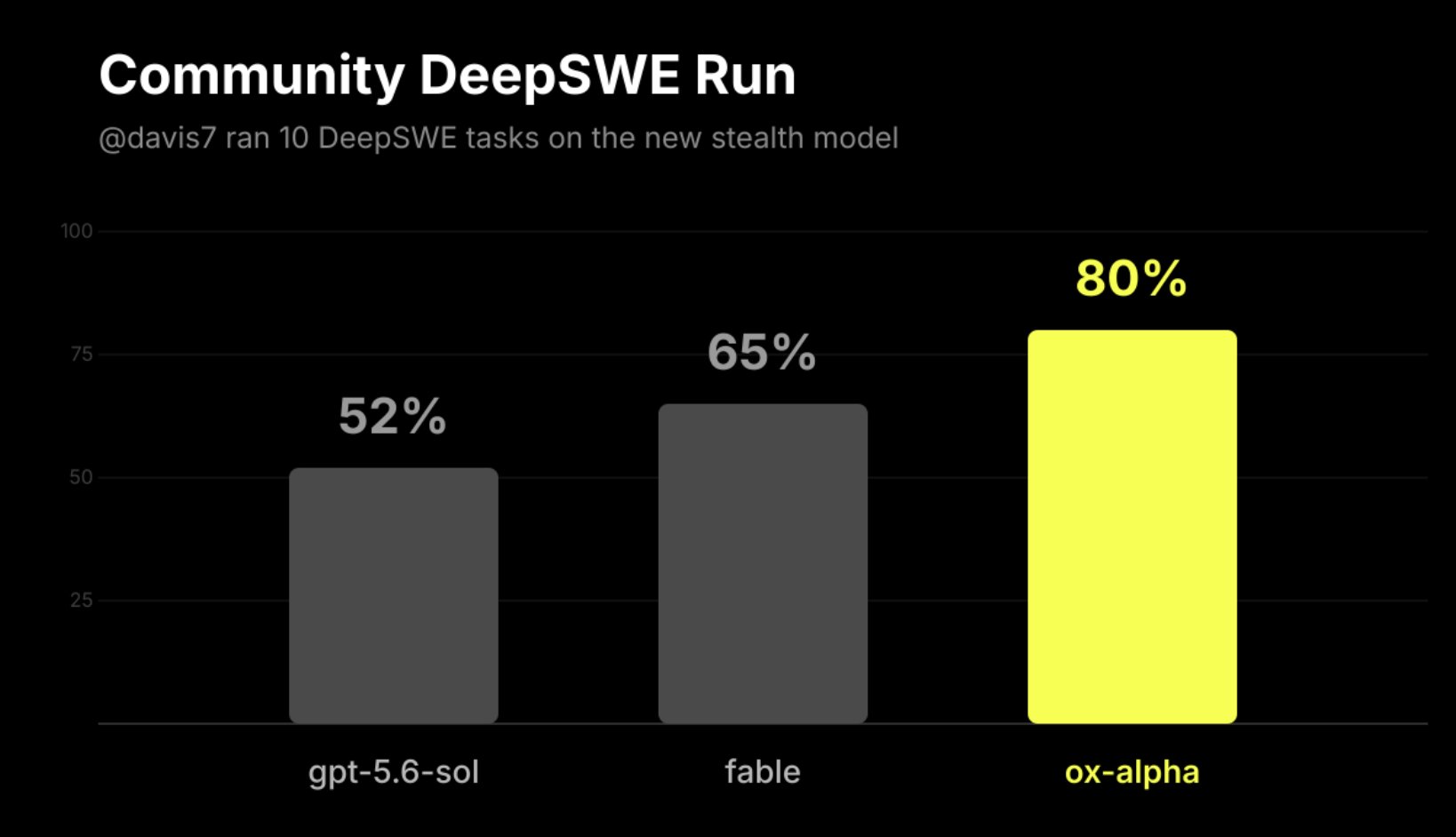
GPT-5.6 Sol
52%
reported completion rate
Fable
65%
reported completion rate
Ox Alpha
80%
reported completion rate
This is the strongest concrete comparison available in the material supplied for this article. It is meaningful because it uses the same task family and puts Ox Alpha beside two recognizable alternatives. It is also small: ten tasks can show a promising signal, but it cannot establish a universal ranking.
A proper follow-up evaluation would publish the task list, exact model versions, prompts, scoring rubric, tool setup, temperature, retries, and failure cases. Until then, read the chart as “Ox Alpha performed impressively in this community run,” not “Ox Alpha is proven best at every coding task.”
Same Prompt, Different Response Shapes
Here is a useful way to think about the difference. Give every model the same task:
The following are illustrative response patterns. They show what to inspect in a response; they are not claims that these exact words were generated in a controlled benchmark.
Ox Alpha — long-horizon / agentic pattern
“I’ll preserve the public API first. Before changing code, I’ll map the request path, identify the hot loop, check query fan-out, and separate measured evidence from assumptions.”
“Plan: 1) add instrumentation, 2) reproduce the slow path, 3) introduce the internal change behind the existing interface, 4) run focused and integration tests, 5) roll out with a rollback point. The first patch only adds the measurement boundary.”
GPT-5.6 Sol — balanced general-purpose pattern
“The likely bottleneck is repeated serialization in the service layer. I’d start by profiling the endpoint and checking payload size before making a change.”
“The lowest-risk fix is to cache the derived representation and invalidate it on writes. Here is a focused patch, followed by tests for cache hits, invalidation, and unchanged API output.”
Claude Opus 5 — explanation-first pattern
“There are three plausible bottlenecks, and the evidence needed to distinguish them is different. I would not commit to one before checking traces, database timings, and the size of the serialized response.”
“Here are the tradeoffs between caching, batching, and moving the work off the request path. I recommend the smallest reversible change, with a test matrix and a note about the failure mode if invalidation is missed.”
None of these shapes is automatically “the best.” Ox Alpha’s stated fit makes the first pattern the one worth testing for long-running repository work. A general-purpose model may be faster for a small one-shot task, while an explanation-first model may be more useful when you are weighing architecture decisions. The right comparison is the response you receive on your real workload.
Where Ox Alpha Looks Most Interesting
- Large repositories: keep more files, interfaces, logs, and migration notes in one working context.
- Long-running coding tasks: maintain a plan across multiple steps instead of restarting from a short summary.
- Agent workflows: reason over a sequence of actions, checks, tool results, and rollback conditions.
- Text plus visual context: combine written requirements with screenshots, diagrams, or UI references where supported by the current interface.
- Exploration: try a new model whose internal identity and final benchmark position have not yet been revealed.
Where You Should Be Careful
A 1M-token context window is capacity, not a guarantee that every token will be equally useful or that a response will be fast. Long prompts still need structure: clear objectives, relevant files, explicit constraints, and checkpoints.
Ox Alpha is also a preview model with an anonymous provider. That means you should treat it as an excellent experiment, not as a substitute for your organization’s approved production model until you have evaluated quality, latency, availability, cost changes, and data-handling requirements yourself.
How Apex Users Can Try It
- Open a new JailBreak AI chat.
- Open the model selector at the top of the chat.
- Select Ox Alpha ⚡ NEW.
- Give it a real, bounded task and compare the response with another Apex model.
Keep the prompt identical when comparing models. Ask each one to state assumptions, show its plan, explain tradeoffs, and identify uncertainty. Save the responses, score them against your actual goal, and repeat with a second task before drawing a conclusion.
Not an Apex member yet? Unlock Apex and try Ox Alpha →
The short version: Ox Alpha is new, capable-looking, unusually large-context, and genuinely mysterious. Try it because the stated workload fit is interesting—not because an unverified headline says it has already beaten every other model.